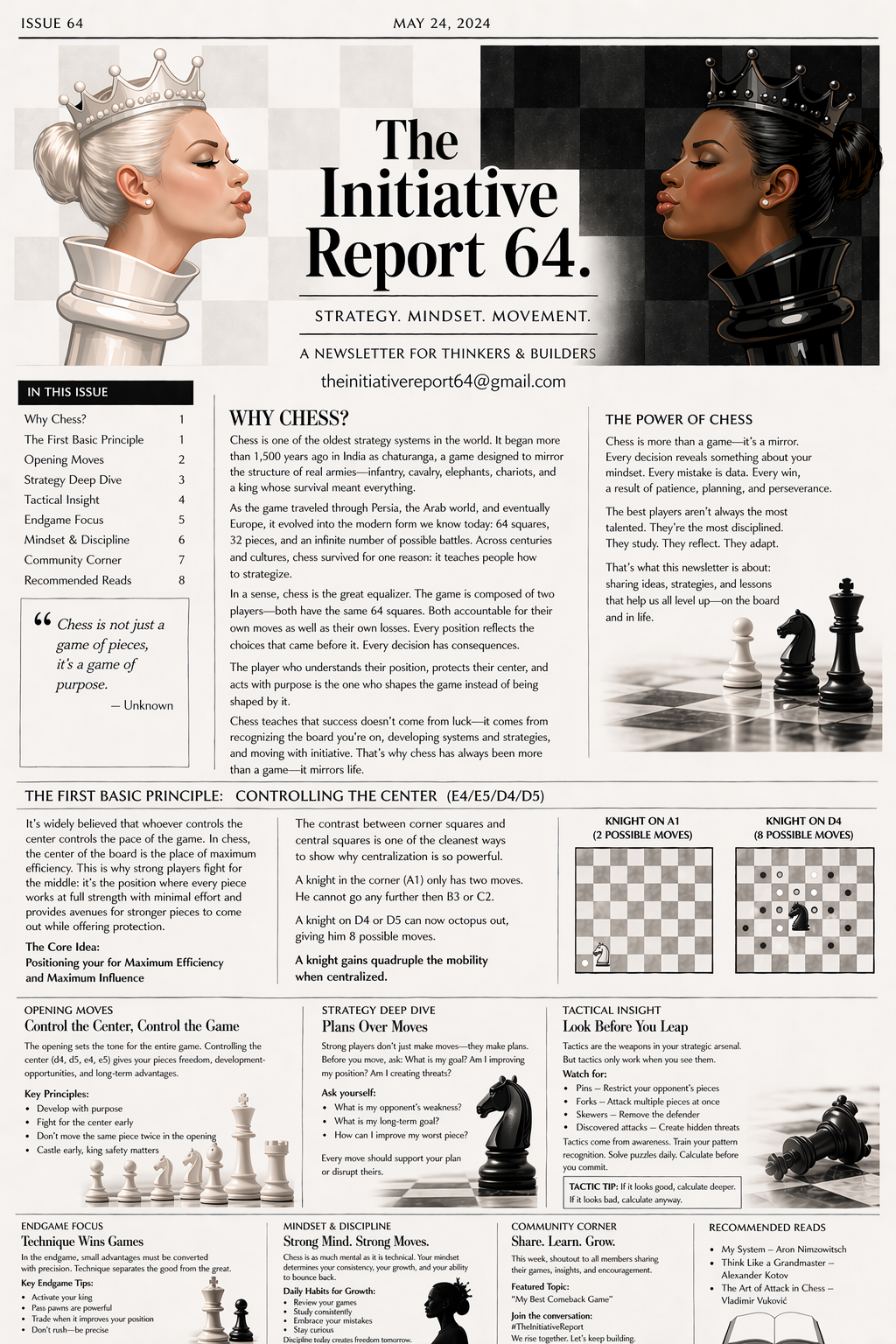
The Initiative Report 64
A monthly mailed newsletter designed for inmates to learn chess, improve critical thinking, and participate in correspondence play.
$10 / month
Delivered directly to your loved one's facility
Important: In your payment memo, include the inmate's full name, ID number, and facility address.
This ensures we can deliver the newsletter and begin correspondence promptly.
More Than a Game — A Real Connection
Each month, your loved one will receive The Initiative Report 64 directly at their facility, along with their initial correspondence chess card.
When they are ready, they simply mark their move and send it through the mail. Responses are returned as they are received from one of our volunteers or supporters.
Unlike traditional correspondence programs, our volunteers are able to communicate beyond the game — creating meaningful interaction, encouragement, and connection through every exchange.
Every move becomes a conversation. Every exchange builds connection.
How It Works
01
Send Payment
Use Cash App or PayPal to subscribe for $10/month.
02
Add Inmate Info
Include full name, ID number, and facility in the payment memo.
03
We Mail It
The newsletter is mailed monthly directly to the facility.
04
Play & Connect
Correspondence chess and real dialogue with caring volunteers.
Why Chess Matters
Chess is a universal game and, within prison, it has become one of the most common and accessible pastimes. Its value goes beyond entertainment — it naturally develops critical thinking, patience, and strategy.
The connection between chess and the mission of The Initiative Report is rooted in this purpose: helping individuals strengthen their ability to think through decisions, anticipate consequences, and approach challenges with intention.
The Reality
Many incarcerated individuals exist within systems that can create confusion, frustration, and a lack of clarity. While prisons are often described as places of rehabilitation, the reality does not always reflect that goal.
Meaningful opportunities for personal growth can be limited, leaving individuals without constructive tools to navigate their environment.
By focusing on strategic thinking and tactical awareness, The Initiative Report provides a structured and productive mental outlet. Chess encourages individuals to slow down, evaluate options, and consider both immediate and long-term outcomes — skills that directly translate into everyday life.
Our Objective
Our objective is simple but powerful: to get people thinking.
Thinking about their actions, their choices, and the long-term direction of their lives. Developing a strategic mindset can help individuals better navigate their environment, make more informed decisions, and respond to challenges with greater awareness and control.
As Loved Ones
We carry a responsibility to encourage growth, stability, and healthier ways of thinking.
Support from the outside can make a meaningful difference. It's about reminding them to stay grounded, maintain composure in difficult moments, and think about the long-term consequences of their actions.
We Want Them To Come Home
That means encouraging thoughtful decision-making, patience, and self-control — even in environments that challenge those qualities every day.
It also means addressing destructive patterns while there is still time to redirect them. Change does not happen overnight, but consistent encouragement and mental engagement can help shift perspective over time.
Addressing The Root
We can offer love, support, and even financial help — but those alone do not address the root of the issue.
Lasting change comes from confronting harmful behavioral patterns and dysfunctional ways of thinking. Without that deeper work, the same cycles can continue.
True support is not just about providing comfort; it is about helping guide a shift in mindset and behavior.
We Cannot Rely On Institutions Alone
We cannot rely on institutions alone to ensure our loved ones grow mentally or mature in meaningful ways.
Too often, the system emphasizes punishment over personal development, leaving individuals without the support needed to truly reflect, learn, and evolve.
Real progress requires direction, purpose, and opportunities to think differently.
The Power Of Correspondence
If you have a loved one who is incarcerated, they can truly benefit from having someone to correspond with consistently.
A supportive partner in communication can help encourage healthier ways of thinking, offer guidance, and reinforce positive strategies.
Through thoughtful dialogue, you can help promote self-awareness, better decision-making, and a stronger sense of purpose.
The Realities Are Harsh
Most people have little understanding of the harsh realities that men and women endure while incarcerated.
The environment can be difficult to comprehend from the outside — many would struggle to fully grasp it.
Yet for our loved ones, it is constant. It is something they face every day, every hour.
Because of that, consistent support, encouragement, and meaningful communication matter even more.
The Initiative Report Is More Than Just A Newsletter
It Is A Tool.
A way to help individuals think more clearly, act more intentionally, and move closer to a better future.
What Participants Are Saying
"
At first, it was just something to fill the hours. I didn't expect it to matter. But once I started playing, it became something I genuinely looked forward to. The monthly newsletter gave me direction, and the chess games broke up the sameness of the days.
What meant the most, though, was the connection. The person writing back treated me like I was still human. It turned into more than chess. It gave me purpose and something real to anticipate.
— Raymond H., Michigan
"
This one actually challenged me in a meaningful way. It clearly broke down the parallels between chess and everyday life. Working through the material helped me recognize my own impulsiveness, even though I had always seen myself as a strategic thinker.
My volunteer wasn't a chess expert either, so we were able to learn and grow together, which made the experience more enjoyable.
— Kyle W., Nevada
"
When I first signed up, I barely knew how to play chess. Now, I genuinely look forward to every move. In this environment, having something positive to focus on makes a real difference.
The back-and-forth letters make it even more meaningful. It's not just about winning or losing — it's about the connection and conversation that come with it.
— Clarissa P., Texas
"
I never pictured myself playing chess. But my mother signed me up, and once I started learning, I began to understand why this game matters. Chess isn't just a game — it's about life.
It forces you to look at yourself, recognize what needs tightening up, and think more deeply about how to improve your position. The biggest thing I've taken from this sentence has been chess.
— Carlos J., California
Ready to Make a Move?
Subscribe today and give your loved one something meaningful to look forward to every month.
$10 / month